Categorías
Nuevo blog
¿Cuál es el mecanismo de formación del "aumento del potencial de tierra"? ¿Cómo causa daños a los equipos eléctricos y electrónicos dentro y fuera del edificio?
March 19 , 2026Potencial terrestre El aumento de potencial se debe a transitorios de alta tensión generados por la corriente del rayo que entra en tierra. Cuando un rayo impacta en el pararrayos de un edificio o en el suelo cercano, se descargan miles o cientos de miles de amperios de corriente a través del sistema de puesta a tierra. Debido a la resistencia e inductancia del sistema de puesta a tierra, según la fórmula U=IR+L·di/dt, el potencial de todo el sistema aumenta bruscamente entre decenas y cientos de kilovoltios en un lapso de tiempo muy corto.
Principales riesgos:
Descarga disruptiva inversa: El potencial de tierra elevado se descarga a lo largo de las líneas de entrada (líneas eléctricas, líneas de señal) hacia puntos distantes de bajo potencial, rompiendo el aislamiento de las líneas y permitiendo que la corriente del rayo penetre en el equipo en sentido inverso.
Diferencia potencial entre sistemas: Se puede generar una gran diferencia de potencial entre los equipos conectados a tierra de forma independiente dentro de un edificio y el sistema de puesta a tierra principal, lo que puede provocar una falla en el aislamiento de los equipos.
Sobrecarga del SPD: El voltaje real aplicado a través del SPD Supera con creces su tolerancia de voltaje de diseño, lo que provoca daños en el protector contra sobretensiones.
Principios básicos de protección:
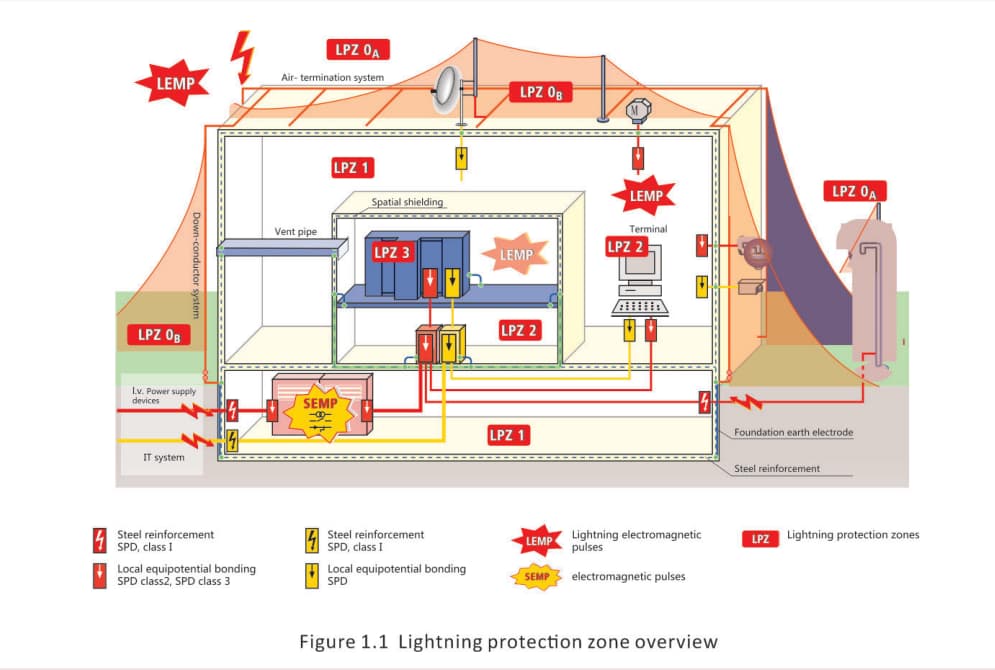
Enlace equipotencial: Esto implica conectar todos los conductores metálicos y los sistemas de puesta a tierra dentro de un edificio utilizando tiras de unión equipotencial para crear un sistema eléctricamente unificado, lo que garantiza un aumento simultáneo del potencial y elimina las peligrosas diferencias de potencial.
Protección coordinada del SPD: Instale dispositivos de protección contra sobretensiones (SPD) compatibles en varios puntos de entrada de la línea para proporcionar una vía de descarga controlada para las corrientes de los rayos.
Optimización de la red de puesta a tierra: El uso de un sistema de puesta a tierra en anillo o malla reduce la impedancia de sobretensión y mejora la disipación de las corrientes de rayos de alta frecuencia.
Este sistema de protección minimiza los peligros del aumento del potencial de tierra mediante el concepto de "igualación del potencial y descarga controlada".
Jinli Eléctrico WeChat

Dirección :No. 97-2 Yonghe Road, High-tech Zone, Hefei, Anhui, China
Tel : 0086-0551-65307363
Correo electrónico : jinlispd@ahjinli.com
Correo electrónico : lynn@ahjinli.com
Whatsapp/Wechat : 15209885162


